Table Of Content
- What is the top-down vs. bottom-up approach?
- Top-Down Vs. Bottom-Up: Which Approach is Better for Your Business?
- Fix these common onboarding challenges to boost productivity
- A Comprehensive Guide to the Top-Down vs Bottom-Up Approach in 2024
- Top-down approach vs. bottom-up approach: What’s the difference?

We will now proceed to unpack the merits and drawbacks of top-down and bottom-up management, offering insights to guide your choice of management style for your organization. Vice versa, while a bottom-up approach focuses on the fundamentals of investments, investors still want to consider systematic effects on individual holdings before making a decision. Generally, while top-down and bottom-up can be very distinctly different both are often used in all types of financial approaches like checks and balances. For example, while a top-down investment fund might primarily focus on investing according to macro trends, it will still look at the fundamentals of its investments before making an investing decision. For example, a portfolio team may be tasked with a bottom-up investing approach within a specified sector like technology.
What is the top-down vs. bottom-up approach?
Top–down approaches are implemented by attaching the stubs in place of the module. But these delay testing of the ultimate functional units of a system until significant design is complete. Bottom-up design contributes to software quality by allowing for better testing of individual components, which can lead to fewer bugs in the final product. It also enhances maintainability by making it easier to update or replace specific components without affecting the entire system. One notable example of successful bottom-up design is the development of the Linux operating system, where individual kernel modules were developed and tested independently before being integrated into the complete system. Bottom-up design allows for early testing of individual components, promotes code reusability, and can lead to more scalable and flexible systems.
Top-Down Vs. Bottom-Up: Which Approach is Better for Your Business?
Sometimes referred to as a stepwise design or decomposition, a system and its goals are broken down into compositional sub-systems in order to gain insight into the smaller aspects that make up a larger system. This format is made more specific with the assistance of black boxes, which make the backward-looking approach easier to follow as upper management pushes down decisions. This delegation of tasks is sometimes referred to as reverse engineering or a big picture outlook because of the way larger goals are fragmented into small tasks that are then handed down to lower level employees. Organizational culture and industry also play a crucial role in the choice of management style. Industries that are more innovative, such as software development and product design, tend to favor bottom-up approaches, as they encourage collaboration and creativity among team members. The top-down approach came to be in the 1970s, when IBM researchers Harlan Mills and Niklaus Wirth developed the top-down approach for software development field.
Fix these common onboarding challenges to boost productivity
The top-down and bottom-up approaches have gained traction in certain sectors of the workforce. Sometimes a highly authoritative upper management and a delegation of tasks is better than employees with fluid roles and a large say in the decisions of a company, and vice versa. Below is a conclusive list of the industries that embody certain management styles over others. There are many industries that benefit from this holistic style of business management. These users embody the use of a pieced together system that creates a more informed, complex company with targeted goals. Sometimes known as parsing, businesses analyze a sequence of information in order to determine its overall function and structure, which leads to the most comprehensive view of a project.
An advocate for the I/O movement and the bottom-up approach, Elton Mayo added to the human relations movement happening during the mid-20th century. Mayo believed that by improving the social aspects of the workplace, the company would ultimately benefit. HR departments dedicated themselves directly to this newfound engagement to employees and their investment in the company. Even more radical divisions of bottom-up management have come to the surface in later years. One such approach is holacracy, which fully leans in to the bottom-up policy and is founded on ideas like transparent and moveable roles in a company, and a circular structure of authority instead of a vertical platform.
Since the decision-making process takes place at just one level of management, they can be finalized, distributed, and implemented much more quickly than decisions that require input from multiple leaders or project stakeholders. The top-down management style is common, which means there’s less of a learning curve for new hires if they came from a company that uses this structure. As a team leader, you can help new team members adjust more quickly by incorporating some familiar elements of top-down methodology into your management style. Then, once an action plan has been created, decision-makers communicate it to the rest of the team to be implemented (usually without much room for adjustment ). LogRocket identifies friction points in the user experience so you can make informed decisions about product and design changes that must happen to hit your goals.
Top-down approach vs. bottom-up approach: What’s the difference?
You should not rely on one approach exclusively, but rather use them in combination to achieve optimal results. One way to do this is to use an iterative or incremental process, where you alternate between top-down and bottom-up phases. The bottom-up approach is based on the assumption that the employees have the best knowledge and experience of the daily operations and challenges of the organization. They are able to provide valuable insights and suggestions that can improve the quality and effectiveness of the decisions. Time is not lost during this testing since it does not wait for all modules to be produced.
Similarly, investors leverage this policy because it is non data-intensive and analyzes the entire economy rather than the ebbs and flows of an individual business or sector of an industry. The top-down style is also leveraged across companies in an effort to budget effectively. Senior project managers create company-wide decisions that trickle down to lower departments.
Advantages of bottom-up management
Socializing Architecture: Top-Down/Bottom-Up - ArchDaily
Socializing Architecture: Top-Down/Bottom-Up.
Posted: Wed, 12 Apr 2023 07:00:00 GMT [source]
In addition, when a system has to be developed from some preexisting components, the bottom-up method is superior since it is more appropriate. One challenge with the top-down management approach is that it requires proactive work to keep non-leadership team members feeling engaged, connected, and respected. When all decisions are made at the top, the rest of the team might feel that their feedback and opinions aren’t valued. The development of the top-down and bottom-up approaches was a result of trial and error in managing, maintaining, and achieving success in a business. Although there are great differences in the two styles, both were created by developing a system that resulted in the most success, revenue, and employee happiness. Keeping all employees, business processes, and departments in mind, leaders who adopt the bottom-up approach encourage input from all areas of the organization.
The engineering and management success of this project led to the spread of the top–down approach through IBM and the rest of the computer industry. Among other achievements, Niklaus Wirth, the developer of Pascal programming language, wrote the influential paper Program Development by Stepwise Refinement. Top–down methods were favored in software engineering until the late 1980s,[3] and object-oriented programming assisted in demonstrating the idea that both aspects of top-down and bottom-up programming could be used. In contrast, smaller, growing companies might find the bottom-up approach more suitable, as it encourages innovation, collaboration, and employee engagement.
After that, the product leaders will start assigning initiatives and features to different product managers and product teams, and the actual work of designing and building them will start. Product initiatives are a high-level representation of the steps the product team should take to achieve objectives and move closer to the vision. They are the key themes (a mix of features and tasks) the company will invest in delivering. In product management, top-down and bottom-up approaches are the two ways to prioritize features, align these priorities with stakeholders, create a well-rounded product management strategy, and make informed decisions.
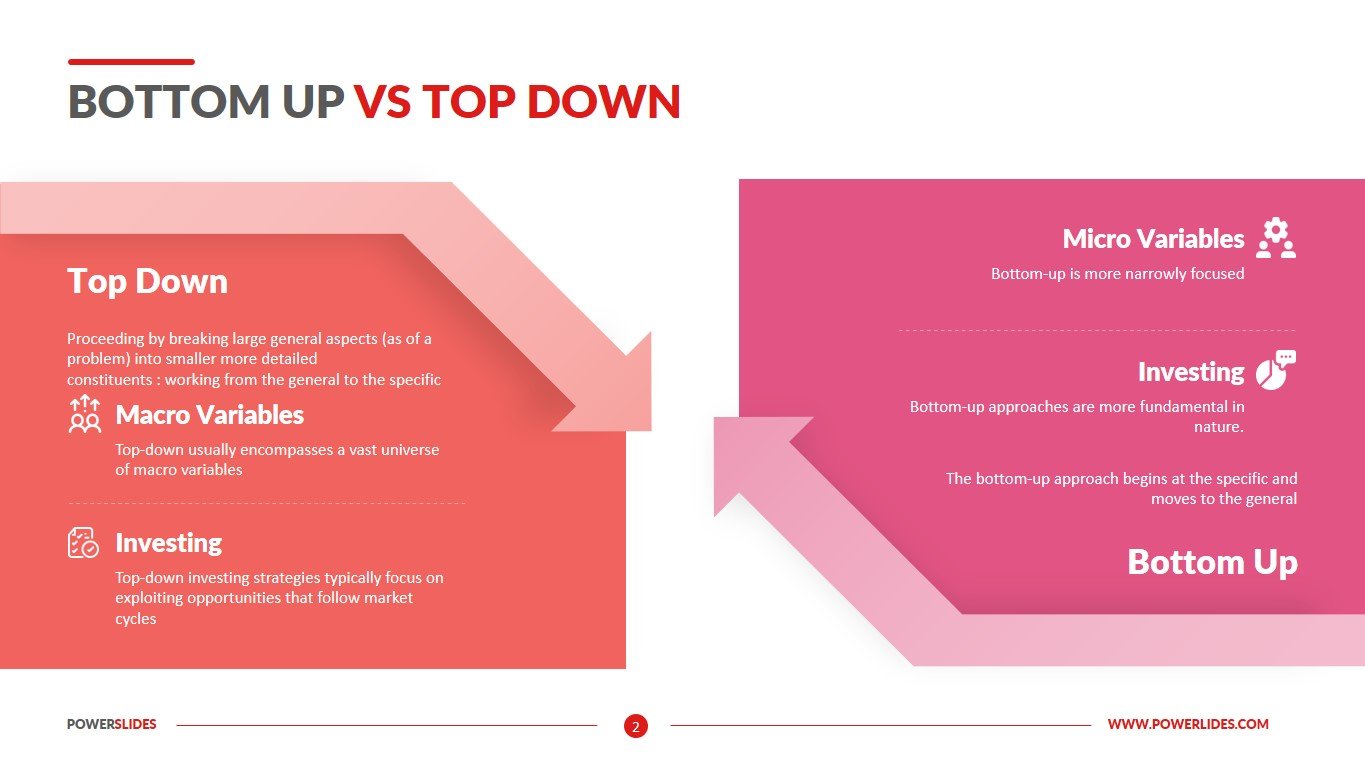
It is a design methodology in which each component is designed as a separate part without any reference to other components in the assembly. In the investing world, top-down investors or investment strategies focus on the macroeconomic environment and cycle. These types of investors usually want to balance consumer discretionary investing against staples depending on the current economy.
Since process-related communication flows top to bottom in top-down companies, it’s easy for individuals and groups to become siloed and eventually feel isolated. Create opportunities for communication across departments, teams, management levels, and even geographical locations to help ensure that your team members can build meaningful relationships with each other. When approaching project objectives from the bottom up, a team will collaborate across all levels to determine what steps need to be taken to achieve overall goals. The bottom-up approach is newer and more flexible than the more formal top-down strategy, which is why it’s more commonly found in industries where disruption and innovation are a priority.
Though it’s important to give team members the opportunity to provide feedback, not everyone is comfortable doing so—especially with leadership in the room. Keep in mind that everyone has different comfort levels and pushing too hard for feedback might stifle honesty or creativity. The bottom-up approach encourages greater buy-in from team members because everyone is given the opportunity to influence decisions regardless of seniority. It also facilitates better relationships between colleagues by offering members of all seniority levels an equal opportunity to influence project outcomes.
These contrasting styles can significantly impact organizational decision-making, employee engagement, and overall performance. This comprehensive guide offers a fresh perspective on these approaches, diving deep into their pros and cons, real-life examples, and best practices for integration. Get ready to discover how to choose and implement the most suitable management style for your organization, leading to a more engaged, motivated, and productive workforce.
They are able to see the big picture and make decisions that align with the overall mission and vision of the organization. Bottom-up testing, which begins at the lowest level of the hierarchy and works its way up, refers to the process of testing crucial modules or functionality at an earlier stage. The primary function of drivers is to satisfy the needs of modules that are either absent or incomplete in order to carry out evaluations of lower-level modules. However, drivers are more difficult to design than stubs since they need more information. The bottom-up strategy, which is used in situations in which the primary module is not yet available, makes use of drivers. When the higher-level modules have not yet been established, drivers are tested to ensure that the lower-level modules function properly.


No comments:
Post a Comment